Women With Festive Tribal Masks Art by Female Artist
African masks
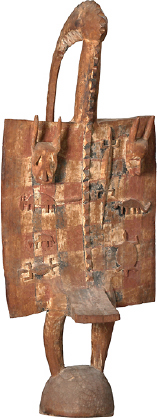 Senufo bird head crest
Af rican masks are peradventure the about admired and well known art grade of Africa.
They are both idea and form. The artistry of African masks is cocky evident but, for the people who create them, they have a much deeper meaning than surface beauty.
In general, the mask form is a concrete machinery to initiate transformation whereby the wearer takes on a new entity, assuasive him to take influence on the spirits to whom he is appealing to or offering thanks.
The Western viewer is oftentimes caught off guard by the emotions that a mask can evoke. Our intrigue can speedily be transformed to a powerful connexion not oft experienced in our frequently disassociated worlds.
They therefore yield some notion of power which the viewer can be attracted to or repelled past. This likewise is despite the fact that often the viewer is studying the mask out of context and without its accompanying costume or props. Something mystical is transferred by the nature of its function.
The traditional African mask is worn during celebrations, dances and festivities and ritual ceremonies commemorating social and religious events. They play a very pregnant spiritual and functional role in the community and often there is no stardom between social recreation and ritual celebration.
African masks are more often than not part of a unified feel, and then while we may encounter them equally sculptural forms they can also be considered equally a form of performance art and agreement their function within this outcome is essential to affectionate their cultural, symbolic and artful significance. They are often used in dance ceremonies to make the connectedness between the human world and the spirit world. Masquerades acquit not bad religious and cultural significance for participants including the enthralled and continued audience.
The African mask is a dramatic device enabling performers to stand autonomously from their everyday role in society and wearers are often chosen for special characteristics or qualities they accept attained or been initiated into.
African masks are in high demand from fine art collectors and museums the world over are reworking their archival collections to present masks in a new and vibrant format which, mostly, focus on the beauty and variety of form of the sculptured piece.
Seeing a row of African masks from unlike tribal areas can show upwards all the contrasts of course, shape, colour, design, patterning and beautification which exist and propose the dazzling range of formal possibilities achieved by African sculptors. Simply lose the connection of a carving with its original function and it is very difficult to institute the purpose for which information technology is created.
Master carvers of masks exercise withal exist; it is a skill that earns respect within a community and a tradition that is passed downwards inside a family through many generations.
Carvers undergo many years of specialized apprenticeship until achieving mastery of the art. It is creative piece of work that not only employs complex craft techniques but as well requires spiritual, symbolic and social cognition. The aura and presence of masks can put them among the near charismatic of whatsoever sculptures ever produced and the sense of play in some of the masquerade masks make them some of humanity's richest and nearly vibrant visual creations.
African masks are worn in iii means:
- Vertically covering the face
- Equally helmets, encasing the entire head
- As a crest, resting upon the head which is commonly covered by material or fibre to continue the disguise
A mask used for spiritual purposes can frequently simply be worn one time and so thrown away or burned, once its function has been performed. An initiation mask seldom survives the anniversary .
Imagine how many art pieces have been lost to the world!
I know from art college how torn I was to sculpt an figure and then be made to burn down information technology on the embankment in some defiant ceremony to prove that the energy and thought procedure required in production of the piece was the compelling and meaning component.
For the African artist, the purpose of creating the mask was accomplished one time the ritual performance was over. There was no attachment to the piece but the skill and the feel is carried forward and handed downward the line of descendants. The viewing of a mask or ceremonial events can also often be restricted to certain peoples or places; there is a lot of tradition and taboo surrounding this art course. In many instances masquerades are forbidden to be seen by sure members of the customs.
Materials used:
African masks are primarily carved from wood but tin also exist fabricated of terra cotta, glazed pottery, statuary, brass, copper, ivory or leather.
They are adorned and decorated with cloth, raffia and other plant fibres, shells, beads, institute objects like porcupine quills and other natural objects, feathers, horns, paint, kaolin, nails, coloured glass.
Ceremonies
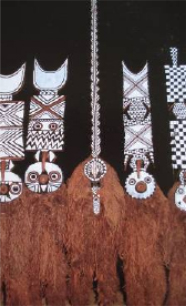 Bobo plank mask, Beckwith and Fisher
African masks are mostly representative of some sort of spirit and the spirit is believe to inhabit and possess the dancer every bit they take part in the operation. Music (primarily drums), dance, vocal and prayer are all tools used to induce a state of trance past which this transformation can occur. Some of the spirits these masks evoke are represented in mask depicting women, royalty and animals.
A translator who is often a wise being who holds status within the community helps with the communication to the ancestors and the translation of the messages received, deciphering the groans and utterances of the dancer.
Rituals
In rituals, African masks represent deities, mythological beasts and gods; metaphors for good and evil, the dead, animals, nature and any other strength that is considered more than powerful than homo himself. A mask tin office as a receptacle for prayer and appeal to the Gods for benevolence and appeasement or on the other cease of the calibration, power and bravery in battle. Some of the rituals performed are for...
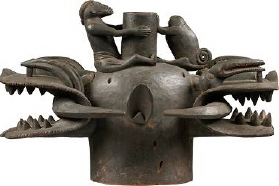 Helmet mask
- Initiation into manhood/ womanhood/machismo
- Circumcision
- Fertility
- Hunting grooming
- War preparation
- To cease devastation/invasion by human or natural forms/protection
- Witchcraft or magical rites
- Expulsion of bad spirits, village purification, execution of criminals
Celebratory
These are performed with groovy vigour and spectacle and the African mask is often role of an elaborate theatrical issue, a masquerade with costumes and props created to enthrall and entertain. Some of the celebrations occur around...
- Storytelling, expressing social expectations and conventions
- Crop harvesting
- Abundance and prosperity
- Market place day festivals
- Post hunt gratitude
- Post war victory
- Consulting the oracles
- Resolving of disputes
- Burials
- Commemorative occasions
- Rejoicing
Tribal masks
African tribal masks have a known history as far dorsum as the stone age. For thousands of years, rituals and ceremonies were an integral part of community life. Unfortunately, these days it is less so and since many tribes accept lost their cultural identity through tribal dispersement and fragmentation for diverse reasons, authentic masking ceremonies no longer occur in many parts of Africa. In that location are very specific masks for very specific ceremonies which have their own function and pregnant.
To study all these would take a lifetime!
All the same, there are some prominent tribes and communities to whom masks and mask ceremonies have been a significant form of societal life and historically accept defined their culture.
They tin can be examined in more item on dissever pages, run across African Tribal Masks...
- Bwa, Mossi and Nuna of Burkina Faso
- Dan of Republic of liberia and Ivory coast
- Dogon and Bamana of Mali
- Fang (Punu) and Kota of Gabon
- Yorubo, Nubo, Igbo and Edo of Nigeria
- Senufo and Grebo, Baule (Guro) and Ligbi (Koulango) of Ivory coast
- Temne, Gola and Sande (Sowei) of Sierra Leone
- Bambara of Mali
- Luba (Lulua) Songye, Teke, Goma, Lulua, Hemba and Kuba of Democratic Republic of Congo (DRC)
- Chokwe of Zambia and Angola Makonde of N Mozambique
Gimmicky Fine art Mask
Romauld Hazoumeb 1962, Porto Novo, Republic of Benin
He is essentially a brilliantly inventive assemblagist who is committed to conveying African art traditions frontwards while finding a new manner to portray the dilemmas currently assuaging the African continent. He reworks what is sent by the West in terms of throwaway consumerables and delivers them back in a confrontational art form.
In the mid-1980'southward he began sculptural experiments with blackness jerry cans which are carried in slap-up clusters on the back of bicycles and motorbikes in his dwelling state. They are often the cause of fatal explosions since they are expanded and thereby weakened over rut to obtain more capacity. Romauld has used these cans as a powerful metaphor of slave repression, pushed to extreme before breaking betoken.
His Masks Collection transforms salvaged materials and industrial waste into spiritual objects. They are incredibly effective in carrying the same sense of power nosotros see in traditional African masks with a sense of foreboding and a slightly confrontational aspect.
Unlike traditional African masks which take on identities, these masks each take their own personalities and characters; they can be state of war-similar, comical, animalistic, self portrait merely the central theme is that their cadre is made from plastic fuel canisters, a symbol of negotiation, corruption and mis-use of ability in Africa. (Dealing in fuel often involves illegal cross edge smuggling). The handle becomes a nose and the gaping snout and sculpted panels suggest facial features. Beautification tin can be found anywhere from industrial waste to constitute natural items like porcupine quills.
His work is reflective of an enduring African cultural art form that can be seen in the works of Joseph-Francis Sumegne and Dilomprizulike of Nigeria among many other artists who work with institute objects.
Joseph-Francis Sumegneb 1951, Cameroon
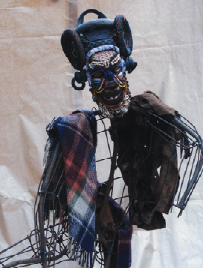
Sumegne'south sculptures are a true reformation of waste and rejects that are fabricated mainly from wire/scrap atomic number 26 and material that he has nerveless and stored in his workplace.
For me they showroom the aforementioned qualities as African masks do, slightly sinister and enigmatic merely with strong bearing and course.
Nick Cave b 1959, Missouri, United states
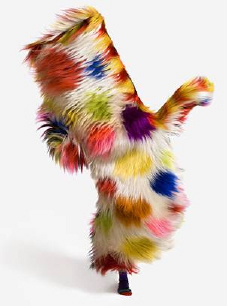
Nick Cave is not African merely his work is so infectious and inspirational that he has to exist included in this contemporary African art section just for the joy and pleasance of being exposed to his amazing installations.
He has undoubtedly been influenced by tribal masquerades and his 'audio suit' installations and accompanying videos are very reminiscent of all that those ceremonies conjure upward for all participants be they viewer, listener or performer.
He uses all manner of found objects to create his suits; sequins and fur, bottle caps, sticks; metallic and wooden, fabric, hair, ordinary materials that he transmutes into multi-layered, mixed media sculptures.
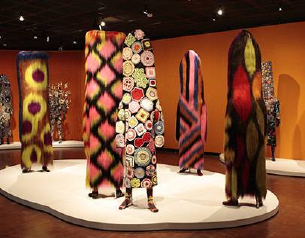
Picket his extraordinary sculptures come to life on You Tube.
Click the links below each image to watch in a new window...
Source: https://www.contemporary-african-art.com/african-masks.html
0 Response to "Women With Festive Tribal Masks Art by Female Artist"
Post a Comment