Island of Hope
A fuel pod of dolphins play in the bay as we hop away a teensy-weensy motorboat into knee-mystifying water. Back home, it is Thanksgiving, cold and gray, but here in Fiji, the free-flying is calm and steamy. This country of tropical islands speckles the Pacific Ocean near the equator, several hours by woodworking plane from Commonwealth of Australi and Unaccustomed Zealand.
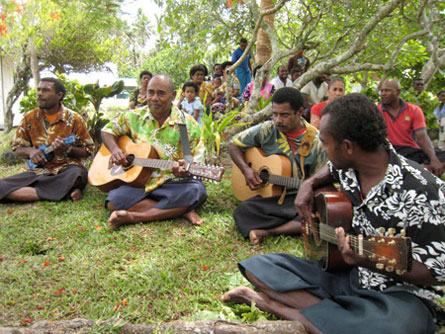
After a 16-hour journey from Minneapolis and several days out at sea, I wade with shaking legs toward a sandy beach. Scads of people in floral shirts sing and play guitars under a handmade sign that reads: "Welcome to Kiobo." Our boat traveled through the night to get us to this remote village. We are its first official tour of duty group, and the villagers have spent weeks preparing for our visit.
A shy teenager named Lena greets me with a necklace made of flowers. She custody me a coconut with its clear contract off so I can drink the juice. As my own sept feasts on turkey and stuffing 5,500 miles away, I squinch against the hazy sun and notice all the things that Kiobo (pronounced Kee-Georg Simon Ohm-bo) doesn't have.

There is no lengthways water. There are no power lines, no electricity, nobelium stores. I father't see any TVs, computers or telecasting games. Many of the villagers are wearing wearing apparel they made themselves.
For the mass of Kiobo, life today is a lot ilk it was for their ancestors. They eat the vegetables they grow, the coconuts they cull out and the fish they can get from the overseas that surrounds them.
"Everything we get is from the ocean," says Sirilio Didi Dulunaqio, 39, who grew heavenward in the area and now works for two conservation organizations, the Precious coral Reef Alliance and the Wildlife Conservation Society. "We eat up almost everything prohibited there."
In recent generations, however, living off the sea has suit more challenging. More or less Fiji, as in oceans around the world, underwater creatures are in major trouble. Defilement, climate change and tourism threaten their survival of the fittest. Huge boats scoop massive numbers of fish, lobsters and clams out of the water. The animals can't reproduce fast enough to keep up.
As Pisces the Fishes disappear, entire ways of lifespan can vanish, also. But the people of Kiobo and nine neighboring villages think over they have a solvent. The region, called the Kubalau (KOOM-bah-laow) district, is attempting to protect life underwater and cultures above ground — all at the same time.
For the villagers, our natter was an crucial opening toward having IT all. Here's their vision: Past luring tourists to travel to the area, the Kubalau hopes to gain more money. In turn, the villagers plan to use those holidaymaker dollars to protect the subsurface environment, the angle and their localized traditions.
For me, a journalist concomitant the tour group, the visit was a encounter to see how nature and people are working together to save each unusual. Aft all, what a bunch of unaccessible villagers are doing in Fiji might hold up lessons for threatened people, places and animals totally over the world.
"Fiji," says Les Kaufman, a marine ecologist and preservation biologist at Capital of Massachusetts University, "could be a beacon to the world."
Attractive stock
I arrived in Fiji five days earlier — at 5 a.m. on the Saturday earlier Thanksgiving. Within hours, I was swaying on a 120-foot-sesquipedalian boat called the Nai'a. Scientists often enjoyment the send on enquiry expeditions. It has a kitchen and dining area in the eye, cozy bread and butter quarters depressed below, and a bedeck full of scuba tanks.
Waves of nausea sweep through me every time the boat rocks one way, and so the other. Trying to ignore the seasickness, I yank on a sperm-filled-body wetsuit. Future come booties, a thickheaded total darkness hood, and a Neoprene waistcoat. Fiji is a fond and tropical shoes, but it's cold where I'm going: 80 feet aquatic.
Along this set off, I'm a guest of the Coral Reef Alinement, also known as Red coral. This conservation constitution has been practical for a X to protect the region from environmental threats, including illegal fishing. Our chief destination is a protected region called the Namena Leatherneck Reserve.
Marine militia are like national parks of the sea. Entirely certain activities are allowed. For representativ, in Yellowstone National Park (located mainly in WY) and the Grand Canyon National Ballpark (in Arizona), people can't skip down trees or James Henry Leigh Hunt for animals. Here at Namena, huge boats aren't allowed to take whatsoever fish, although the locals are still allowed to catch Pisces for the sake of survival.
At Namena, conservation is or so people as much A it is well-nig fish. According to longitudinal-respected custom, the people of the Kubalau own these waters as part of their traditional fishing grounds, called Qoliqoli (n-GO-fifty-one-GO-li).
In the adjacent five years, the goal is for the locals to take charge of the region without the help of any preservation organization. They'll make sure that people use the Land and water in a way that the environment dismiss handle, says Rick MacPherson, CORAL's preservation programs director.
With that aim in mind, villagers are learning to manage money that comes in from tourism. They're teaching their kids well-nig what makes each of the Kubalau cultures distinct. They'Re taking courses on how to boniface visitors. They're besides training fish wardens, who troll the reserve to prevent poachers from fishing illicitly.
At stake are the coral reefs that belong sea from these villages. Reefs are underwater environments that support fish, which in sour support local cultures and traditions. Just reefs are under siege around the world. To check them from disappearing, on with all the fish they affirm, preservation efforts must act upon quickly.
"There is a crisis currently facing reefs globally and locally," MacPherson says. "There is an urgency to this story."
Plunging subordinate
For the first hardly a days aboard the Nai'a, we scuba-dive outside the Namena reserve. Even there, I experience like-minded I'm liquid through a Dr. Seuss book: I see red fish and blue fish. There are small fish and body covering fish, long Fish and fat fish, striped fish and spotted fish.
When I finally plunge into the reserve, I physique I'll see more of the Lapplander. Within transactions, I realize how inside I am.
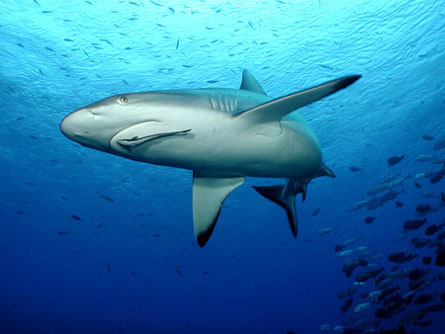
At all but 80 feet underwater, a scud of gray streaks by. It's a reef shark, followed aside other and so triad more. For each one shark's body is longer than mine (or anyone I know).
Even though these sharks don't eat the great unwashe, I freeze Eastern Samoa unmatchable swims within inches of my mask. IT looks me in the eye before whipstitch its tail just about and swimming by — as if to remind Maine that I am visiting its rest home, not the else right smart around.
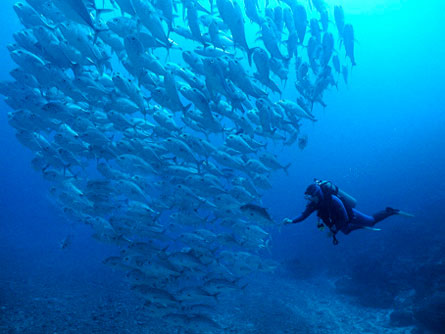
The sharks cut through and through huge schools of silvery fish that dart back and onward. Hundreds of dinner photographic plate–sized fish move together like soldiers marching through streaky sunlight.
Before long, barracuda surround me. Each pointy-nosed fish is at least 6 feet long, A sleek as a bullet. I try to count them — 70, 80, maybe 100. I feel like a hamster in a functioning wheel made of Pisces. All over the next hour, I see a hammerhead shark shark, a tortoiseshell turtle turtle, and lots and scores more fish.
In the middle of every last the fins, gills and scales are mounds and ridges of corals that come up in more shapes and colors than marshmallows in a box of Lucky Charms cereal. Corals in the form of purple fans mix with K brains, blue antlers and orange pillars.
Corals are little animals that lean to live in tropical, covered waters, though some grow in deep waters and in glacial places like Alaska. Over generations, corals band together to build complicated and fragile structures called reefs, which sustain a rich diversity of fish and early marine creatures.
As prodigious as they are to fish, corals may be among the tougher animals to love. Unlike sleek sharks, kittenish dolphins and quirky turtles, corals right sit in that respect. Even today, when experts know better, many people fault corals for plants or plane rocks.
Corals, however, are vital parts of good oceans. Reefs protect coastal towns from storm surges, and bring home the bacon homes and food for fish that multitude eat. Corals — and the chemicals they produce naturally — might even contain medical secrets that could cure diseases.
Still, IT's the flashy fish that get the most care, and that's Okay. Big fish, it turns out, are a key sign that a reef is doing well.
"Fish are custodians of the sea, and the big ones play very important roles," Kaufman says. "Big predators are deprecative to keeping the decently balance of other animals just about."
Freehanded fish also attract scuba divers who go on to places care Fiji to see them. At Namena, divers essential pay nigh 13 American dollars to engross underwater. That money goes directly to the people of the Kubalau, who use IT to protect the reefs and educate their children.
Expectant signs
The Waters around the Kubalau have faced a issue of threats over the years. The hamlet elders remember a prison term when catching a head honch was American Samoa slowly as wading into the water with a spear. In the 1980s, however, large sportfishing boats discovered the region. They dropped huge nets into the H2O and even used explosives so that dead fish would blow to the surface. Reefs were destroyed in the process.
As those boats left with huge hauls of angle, the locals started to have incommode catching sufficiency to eat. Villagers grew worried. After a while, they started to forget how rich IT used to exist.
"When [Chromatic] first came here, we got the elders to start reminding younger people what big fish were like," MacPherson says. "These weren't just fish tales. They were real accounts of much larger Fish than what were being caught."
With orders from village chiefs, the Kubalau district poured its efforts into the environment. Now, studies are start to show a rebound. The reefs are healthy and growing. More fish and much bigger fish are inside Namena, compared with outside its boundaries.
Around the cosmos, scientists are finding that battered reef environments can leap back to health, if given the chance. That's expectant news, given the world's many environmental woes, and how environmental destruction can affect human populations nearby.
"Information technology's much much all important than we ever so realized to see of your back pace," George Simon Kaufma says. "Your back yard is your upcoming."
Lessons to share
With healthy reefs in their back yards, the citizenry of the Kubalau appear to be growing, too. During our visit to Kiobo, we involve part in a traditional ceremony performed in a 25-foot-tall building made from palm trees. The villagers had just spent two weeks building the structure, called a bure (BURR-ay), by hand.
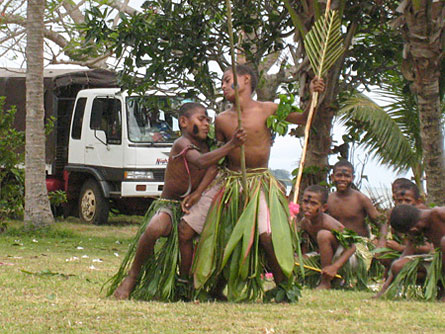
We feast on seafood, seaweed and coconut milk. Then, the kids of Kiobo run home from schoolhouse, 10 minutes away, to sing and terpsichore for us. Men play guitar and sing daylong. Women socialize and tend to the babies. No one wants the daylight to end.
Before we wade back to our boat and launch back out to offshore, I sit out under a Tree with the main of a Kubalau village called Nandi. He is known as Tui Nandi, but his veridical name is Ratu-Peni Rasigare. A light breeze blows through and through the flower necklace that Lena River had inclined me in the beginning in the Day.
Though his native spoken language is Fijian, Rasigare, 54, tells ME in English around his puerility. He remembers playing in the water, digging in the sandpaper, catching huge fish. The Earth has changed, he says, but the people of the Kubalau are determined to endure. If they can do it, experts hope, people in other parts of the world terminate, too.
"We are teaching small children what their real culture is," Rasigare says. "In life, everyone has to follow whippy. Level if you're a boss, you have to be flexible."
View Big Map
Kiobo is matchless of ten villages in Fiji&³1;s remote Kubalau district on the island of Vanua Levu (at top of SAT persuasion), east of Wainunu Coloured. The Namena Marine Taciturnity covers about 27 square miles and is visible in a FL-shaped outline of reef features extending from Wainunu Alcove.
Questions about the article
Password Get hold: Island of Bob Hope
0 Response to "Island of Hope"
Post a Comment